



[KOR]「글로벌 AI 허브」 비전 선포식 개최
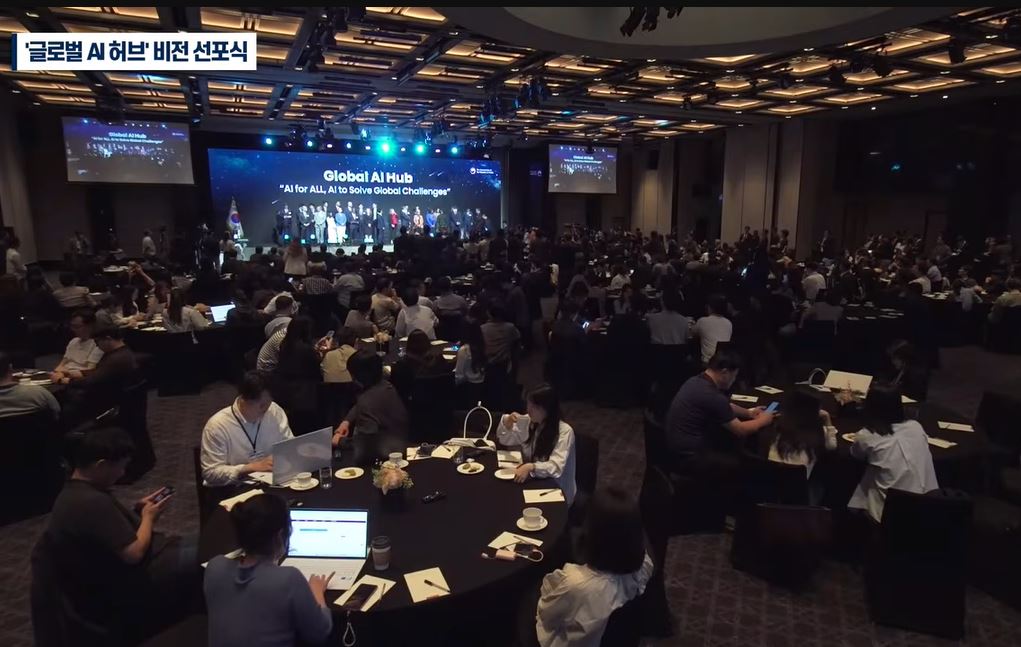

대한민국 정부와 주요 국제기구들이 AI를 활용해 기후위기·보건·식량·일자리·난민 등 인류 난제의 공동 해결에 나선다.
김민석 국무총리와 관계부처는 대한민국 내 조성될 ‘글로벌 AI 허브(Global AI Hub, 이하 ‘허브’)’의 비전 선포식을 5월 21일 개최하였다.
이 자리에는 국제노동기구(ILO), 국제이주기구(IOM), 국제전기통신연합(ITU), 유엔개발계획(UNDP), 유엔환경계획(UNEP), 유엔난민기구(UNHCR), 유엔아동기금(UNICEF), 세계식량계획(WFP), 세계보건기구(WHO) 등 9개 국제기구와 세계은행(WB), 아시아개발은행(ADB), 미주개발은행(IDB), 유럽부흥개발은행(EBRD), 중미경제통합은행(CABEI) 등 5개 다자개발은행(MDB)이 함께하여 허브를 중심으로 하는 범지구적 AI 협력·연계 체계를 구축하기로 뜻을 모았다.
현재 국제사회는 기후 변화, 전염병, 식량 자원 등 단일 기구나 국가의 역량만으로는 해결하기 어려운 복합적 위기에 직면해 있다.
AI는 이러한 위기의 해결책을 찾을 수단으로 각광받고 있으나, 기존의 분절적 대응으로 인해 기술·인프라가 파편화되는 등 한계가 제기되어 왔다. 이에 따라, 국제기구의 AI 기능을 통합하고 인프라 및 역량을 공유함으로써 인류 공통의 위기에 공동 대응할 수 있는 ‘글로벌 AI 허브’ 구축이 시급한 과제로 대두되었다.
이와 관련하여, 대한민국이 보유하고 있는 세계적 수준의 첨단 AI 기술력·인프라와 독보적인 디지털정부 구축·운영 경험이라는 강점은 허브의 핵심 기능을 효과적으로 수행할 수 있는 최적의 자산이 될 것으로 기대된다.
허브는 ➀정책·표준 수준에서 개발도상국 AI 도입을 촉진하고 AI 기술표준·지침을 수립하며, ➁공통 AI 협력 기반 수준에서 데이터·모델·실증사례 공유 등 기관 간, 국가 간 경계를 뛰어넘는 협력체계를 마련하고, ➂실증 수준에서 도구·모델·솔루션 등을 개발하고 실제 활용 사례를 도출하여 글로벌 문제를 해결하는 역할을 선도할 계획이다.
정부와 9개 국제기구는 그간 상호 협의를 바탕으로 구체화한 글로벌 AI 허브의 협력 범위 및 분야를 명시하는 공동성명을 선언하였다.
이를 바탕으로, 허브는 “모두를 위한 AI, 글로벌 과제 해결을 위한 AI(AI for All, AI to Solve Global Challenges)”라는 비전 아래 각국 정부와 학계·연구계, 공익 단체 등 다양한 주체가 한데 모여 협력하는 개방적 플랫폼으로 조성될 계획이다.
아울러 국제기구들이 허브의 첨단 AI 인프라·모델을 공동 활용해 전 지구적 난제의 해결 방안을 모색하고, 개발도상국 등을 대상으로 AI 정책·기술 자문과 교육·훈련을 제공하는 실천적인 글로벌 협력 거점 역할을 수행하게 될 것으로 기대된다.
이 같은 비전 선언에 대해 에이미 포프(Amy Pope) IOM 사무총장, 질베르 웅보(Gilbert F. Houngbo) ILO 사무총장, 도린 보그단 마틴(Doreen Bogdan Martin) ITU 사무총장, 알렉산더 더크루(Alexander De Croo) UNDP 총재 등은 축사를 통해 적극적으로 화답하며, 기관 차원의 역량을 아끼지 않고 적극 협력하겠다는 의지를 밝혔다.
한편, 구윤철 경제부총리 겸 재정경제부장관은 WB, IDB, ADB, EBRD, CABEI가 향후 한국 내에 각각 설립할 예정인 AI 특화센터들과 글로벌 AI 허브와의 연계 방안을 발표하며, 국제기구 중심의 글로벌 AI 허브와 금융 지원 기능을 갖춘 다자개발은행(MDB) AI 허브가 연계된다면 수요 발굴 및 모델 개발·실증부터 개도국으로의 AI 개발사업 확산까지 아우르는 시너지가 창출될 것이라고 강조했다.
정부 관계부처와 허브 참여 국제기구 및 다자개발은행은 이날 선포된 비전이 가시적인 성과로 이어질 수 있도록 실무 그룹(Working Group)을 통해 단계적 실행 계획을 마련해 나갈 예정이다. 또한, 허브의 성공적인 안착을 위해 상시 소통 채널을 가동하고 긴밀한 공조 체계를 유지할 계획이다.
<참고> 글로벌 AI 허브 공동성명
Joint Statement
on Cooperation towards a Global AI Hub in the Republic of Korea
Issued in Seoul, 21 May 2026
1. Preamble
The Government of the Republic of Korea and the participating United Nations and related organizations (the “Participating Organizations”) affirm their shared commitment to enhance safety, accessibility, trustworthiness and reliability of Artificial Intelligence (AI), with human-centered approaches under the vision of a global AI hub dedicated to “AI for All, AI to Solve Global Challenges.”
This Joint Statement builds on the Letter of Intent signed in Geneva on 17 March 2026 between the Government of the Republic of Korea, represented by the Ministry of Science and ICT, and the Participating Organizations, and reflects the progress made since that date in shaping a shared vision for cooperation on artificial intelligence.
The Participants recognize the public systems on which people depend, including health, climate action and environment, food security and nutrition, migration and mobility, humanitarian response, labour and work, universal connectivity and sustainable digital transformation, and other Sustainable Development Goals areas, are facing challenges that are accelerating in pace and complexity beyond what existing approaches alone can address. The Participants further recognize that artificial intelligence is already reshaping these systems, and that the opportunity to shape this transformation in the public interest, alongside governments and people across the Global South, is time-sensitive.
The Participants further recognize the added value of collaboration in addressing these challenges. The value of a shared, collective capability is greater than what any one Participant could deliver in isolation.
2. A Shared Understanding
The Participants note their shared intention to explore the possible establishment of a Global AI Hub in the Republic of Korea, as a collaborative capability to support the Participating Organizations, and, to develop and deploy artificial intelligence in line with their respective mandates and in the interests of the communities they serve.
The Hub is conceived as a collaborative capability, not a single-agency presence. The Hub is expected to be established by the Republic of Korea and shaped jointly by the Participating Organizations, with the intention that additional United Nations entities may join over time, subject to the agreement of the Participants and applicable internal approval processes.
3. Scope of the Collaboration
The Participants envisage that, should such a Hub be established, it could support collaboration across three reinforcing levels.
At the Policy and Standards level, participants in the Hub may engage with governments, academic institutions, and public-interest partners to support the introduction of artificial intelligence into public systems, particularly in developing contexts. This may include contributions to standards, safety, and accountability frameworks, and to the inclusive ecosystems and public sector capabilities that keep this transition accountable, rights-based, and centered on the people it affects.
At the domain level, the Hub is expected to support Participating Organizations in designing artificial intelligence applications across Sustainable Development Goal areas, and related cross-cutting global challenges, including health, climate action and environment, food security and nutrition, forced displacement, refugee protection and solutions, migration and mobility, labour and work, universal connectivity and sustainable digital transformation, and other areas, in accordance with their respective mandates. This work may include complex global challenges that cross borders, organizations and mandates. To effectively address these challenges, they may include identifying and jointly responding to cross-organizational projects based on inter-agency cooperation, as well as sharing data, models, and proofs of concept.
At the delivery level, the Hub may facilitate the development of practical and integrated use cases drawing on shared capabilities in artificial intelligence engineering, AI-ready data and interoperability, responsible AI practice, and talent and adoption, producing tools, models, deployable solutions, and digital public goods.
4. Areas of Cooperation
The Government of the Republic of Korea, as host, has indicated its willingness to fund the establishment, operation and practical implementation of the Hub, subject to the conclusion of appropriate arrangements between the Participants and to the internal approval processes of the Government of the Republic of Korea and each Participating Organizations.
The Participating Organizations intend to contribute, in accordance with their respective mandates, governing instruments, financial regulations and rules, and internal procedures, technical expertise and institutional knowledge to the Hub.
The Participants intend to explore, subject to their respective rules, policies and procedures, structured opportunities for engagement with industry, academia, and research institutions in international artificial intelligence and digital cooperation, without prejudice to applicable recruitment frameworks, competitive processes, geographical diversity considerations, or the independent staffing decisions of the Government of the Republic of Korea and each Participating Organization.
The Participants further intend to engage in various forms of collaboration, including joint research with partners from academia, research institutions, civil society, and private sector partners, including in the Republic of Korea, as part of the Hub’s broader ecosystem, in each case consistent with the rules of engagement of the respective Participating Organizations.
Any such engagement with external partners, including private sector entities, shall be conducted in accordance with the applicable rules, policies and procedures of each Participating Organization, including those relating to procurement, due diligence, conflicts of interest, data protection, information security, intellectual property, and reputational risk.
The Participants share the intention that the Hub will be guided by principles, including responsible and human-centered artificial intelligence, human oversight, rights-based design, transparency, interoperability, openness, data protection and privacy, information security, risk assessment and mitigation, respect for intellectual property, and the protection of people in vulnerable situations, while avoiding duplication across the systems of the Participating Organizations.
5. Coordination and Implementation
The Participants may consider establishing a coordination mechanism to facilitate the inter-agency consultations and information-sharing for the Hub, which comprise technical experts designated by each Participant.
The Participants intend to pursue a phased approach to the establishment of the Hub over the coming years. Early preparatory work will be carried out in 2026, and full operational capabilities developed thereafter, in line with each Participant’s priorities and relevant regulations and procedures.
Additional United Nations system entities may join the Hub over time, subject to the agreement of the Participants.
6. Nature of this Statement
This Joint Statement reflects the shared intention of the Participants as of the date of signature. It does not constitute a legally binding agreement and does not create legal, financial, or other obligations whatsoever for any Participating Organization or for the Government of the Republic of Korea.
The implementation of any activities contemplated under this Joint Statement will be subject to the mandates, regulatory frameworks, and internal procedures of the respective Participants, and to the conclusion of appropriate arrangements where required.
Nothing in this Joint Statement may be construed as a waiver, express or implied, of the privileges and immunities enjoyed by the Participating Organizations under applicable international law.
Each Participant will be fully responsible for its own actions and activities, including the actions of its staff, consultants, and other personnel or contractors.
7. Closing
The Participants look forward to advancing this shared endeavor in a spirit of partnership, and to the Hub becoming a recognized contribution to the responsible development of artificial intelligence.